
Shopping centres revisited: growth returns to prime destinations

The picture in 2026 is more nuanced. Many of the UK's prime destinations have recovered strongly over the last few years and continue to attract retailers, shoppers and investment. Performance is increasingly being shaped by the quality of the asset, the strength of its catchment and its ability to offer more than a traditional shopping trip.
The retail sector is polarised - it's a tale of two markets
Many secondary and tertiary centres, however, are being repositioned through alternative uses, redevelopment opportunities and wider regeneration initiatives. This is creating a clearer distinction between dominant destinations and assets that need to find a new role within their local communities.
In prime centres, vacancy rates and rents are moving in the right direction
Vacancy rates across prime shopping centres fell from 13.7% in 2024 to 11.5% in 2025. Although this remains slightly above the 10.2% recorded in 2019, the latest data show that much of the increase in vacancy seen since the pandemic has now been reversed.
The improvement is stronger than the national shopping centre position, which remains high at 16.1% in Q2 2026, but has declined compared to the first quarter of the year and improving faster than other retail sub sectors. The comparison reinforces the distinction between prime centres, where occupier demand is helping to absorb space, and the wider market, where vacancy remains more heavily concentrated in secondary schemes.
Average prime rents reached £256 per sq ft in 2025, up 7% compared to 2024. Although the 2025 average remained below the £313 per sq ft achieved in 2019, the recent uplift shows that rental levels are beginning to recover across prime shopping centres.
Shopping centre visitor numbers continue to recover
Analysis of visitor numbers across the UK's prime shopping centres shows that footfall has largely recovered to pre-pandemic levels, with several destinations seeing more visitors than they did in 2019. This underlines the continued appeal of well-located shopping centres that combine a strong retail offer with leisure, food and beverage and other experience-led uses.
% change in prime shopping centres visitor numbers 2019-2026

Source: Visitor Insights
Note: Visitor numbers represent total footfall recorded between 1 January and 30 June each year. St James Quarter has been excluded from the 2019 comparison because it was not fully operational during the comparison period.
The evolution of shopping centres - more than shopping
One of the most important changes in recent years has been the continued diversification of shopping centres.
Landlords have broadened their offer to create more reasons to visit. Leisure and entertainment brands, healthcare providers, educational institutions, workspace operators and public services are all playing a greater role within many schemes.
Shopping centres are therefore evolving into mixed-use destinations that bring together shopping, leisure, dining, community services and experiences. For many schemes, this broader mix is helping to maintain relevance, increase dwell time and support footfall growth.
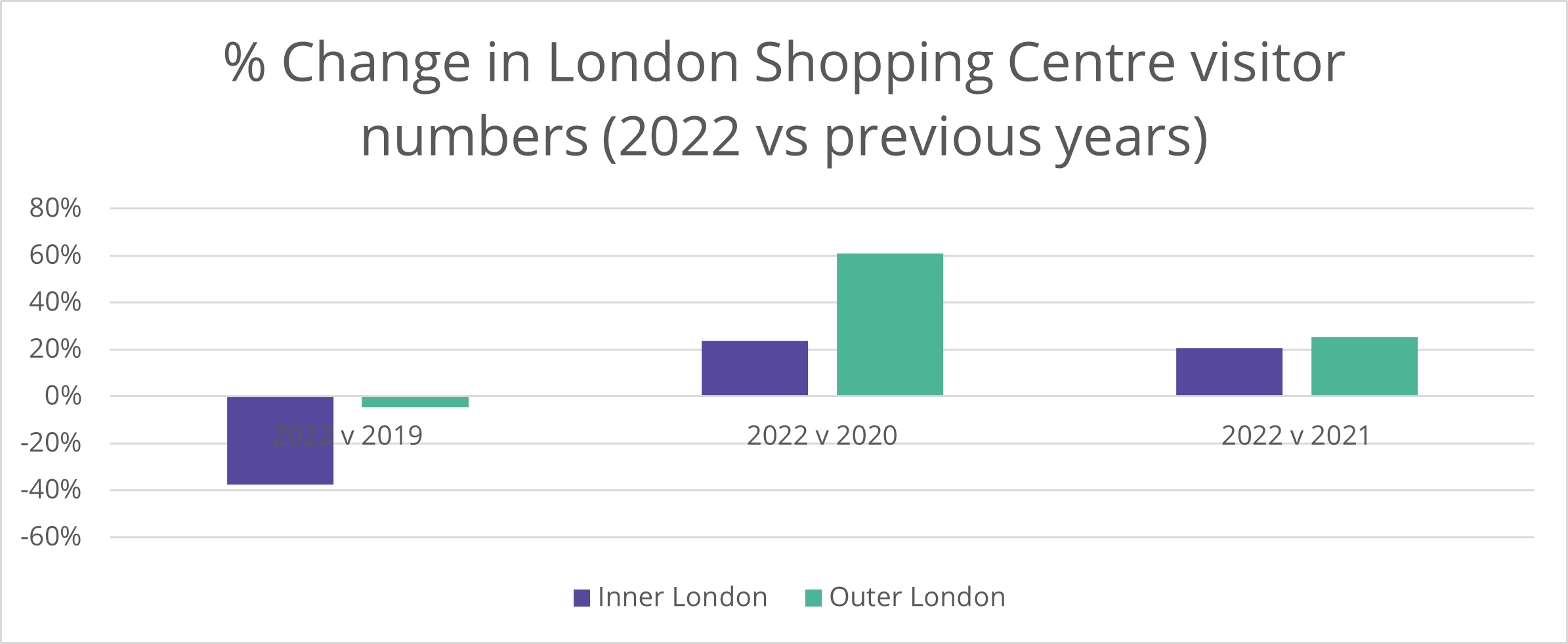
Source: Visitor Insights
Investment interest in prime retail assets has increased
Investor appetite for shopping centres has strengthened considerably over the last two years, although demand remains highly selective. Rather than seeking exposure to the sector, investors are increasingly targeting a small number of dominant regional and super-regional destinations with strong catchments, resilient occupier demand and opportunities to drive future income growth. This growing confidence reflects improving operational performance, stabilising values and the recognition that the best assets continue to attract both retailers and consumers.
Perhaps the clearest example of this trend is Landsec's increased focus on major retail destinations. The company has stated that it is targeting the "top 1%" of shopping centres and continues to increase its exposure to prime retail, reflecting a belief that the strongest assets will continue to capture a disproportionate share of retail spending and occupier demand. Around 86% of its retail portfolio is concentrated within the UK's top 1% of retail destinations.
The improving outlook is also attracting new investors. Realty Income, one of the most active investors in UK retail property in recent years, entered the UK shopping centre market through its acquisition of The Lexicon in Bracknell, having previously focused primarily on supermarkets and retail parks. Its entry into the sector is viewed by many as a sign of growing investor confidence in the prospects for prime shopping centres.
Retailers themselves are also becoming increasingly active investors. Frasers Group has continued to expand its ownership of retail destinations, acquiring shopping centres and designer outlet schemes as part of its wider strategy to strengthen its physical retail platform. This reflects a broader belief amongst some occupiers that owning strategic retail assets can provide long-term control over locations whilst supporting brand growth and customer.
Together, these trends suggest that confidence is returning to the sector. While investors remain selective, there is growing evidence that dominant shopping centres are increasingly viewed as attractive long-term assets capable of delivering both income growth and value creation.
What's next for shopping centres?
There is no single model for the future of shopping centres. Each location has its own catchment, competitive position and opportunities. However, the performance of many leading destinations shows that well-invested, well-managed centres with a strong and evolving offer continue to have an important role within the UK's retail landscape.
The strongest schemes are attracting retailers, investment and growing visitor numbers. As landlords continue to diversify uses and improve the customer experience, prime shopping centres are well placed to build on this momentum and reinforce their position as retail, leisure and community destinations.