Bank of England reluctant to hike rates
 30 April 2026
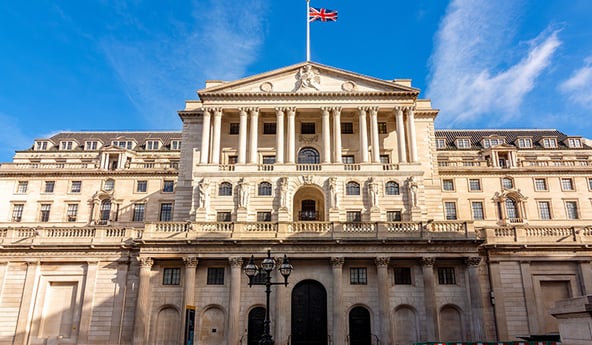
Thursday saw the Bank of England Monetary Policy Committee (MPC) leave the Base Rate on hold at 3.75%, mirroring the actions of the US Federal Reserve, the Bank of Canada and the ECB at their respective policy meetings this week.
An interesting development was the split in the MPC rate setters’ vote, with eight supporting no change, and just one favouring a hike. This demonstrates that policymakers in the UK, and indeed overseas, are reluctant to raise interest rates in the face of the current energy price shock. This is because higher oil prices have come at a time when the economy was already sluggish.
In the press statement that accompanied the MPC’s decision, rate setters observed that while the war in the Middle East has driven up petrol prices, there is uncertainty on whether this will lead to ‘second round effects’, where the inflation transmits to non-energy prices. In particular, the MPC speculated that, given the high inflation of recent years, many firms may now be worried that raising prices further could drive customers away. Also, with the labour market in a slowdown, there was doubt whether workers might demand big pay rises in response to higher inflation.
The Bank released three forecast scenarios based on how long energy prices remain elevated. In a best-case scenario, where energy prices quickly normalise, the forecast was for no second-round effects for inflation. In contrast, in the worst-case scenario, inflation is predicted to reach 6.2% in Q1 2027, with the Base Rate rising to 5.25% in response.
Nevertheless, at the press conference, Governor Andrew Bailey said of the energy price shock from the war: “A resolution at the source – re-opening the Strait of Hormuz and repairing the damage that has been done to the world’s energy infrastructure – can, however, reduce the impact of this negative supply shock to our economy”.
This is the MPC reminding us that it is not saying the worst-case scenario will definitely happen, and in the event of a breakthrough in the peace negotiations that comes sooner rather than later, energy prices could retreat quickly, easing inflationary pressures. So, were there a speedy resolution to the conflict, talk of Base Rate hikes could soon come off the table. Indeed, the Governor went on to say: “The monetary policy committee’s remit recognises that attempting to bring inflation back to the target too quickly after a shock like this may cause undesirable volatility in output.”
Bailey went on to explain that the impact of a Base Rate increase takes time to reach the economy, and its dampening effect could arrive after energy prices have fallen back, meaning higher interest rates just cause unnecessary harm. The Governor also emphasised the sheer volatility of oil prices at present, cautioning against reading too much into the Brent crude price on any given day.
In its accompanying press release, the MPC noted that the tightening of conditions in the financial markets also meant there was less need to increase the Base Rate. The 10-year gilt yield is currently just over 5.0% at the time of writing, compared to around 4.2% on the eve of the war’s outbreak.
In conclusion, we believe the Bank of England is in no hurry to raise the Base Rate, and the alarming worst-case scenario forecast was probably released by the Bank to cover itself, given the high level of uncertainty at present.
In our opinion, President Trump will soon need to pivot from foreign affairs to domestic politics, given Midterm Congressional elections are coming later this year. US gasoline prices above $4.00 a gallon are viewed as politically damaging, and the current national average is $4.30, according to AAA. Of the six US states that in the 2024 Presidential election swung from Democrat to Republican, four now have gasoline prices above the national average. While the Strait of Hormuz remains closed, the possibility of a Base Rate hike cannot be ignored; but if US domestic political pressures do persuade Trump to make peace sooner rather than later, we also believe that a rate rise from the Bank of England could yet be avoided.
